

One of the projects that I am most intrigued about is the Town of Wake Forest’s restoration and interpretation of the Ailey Young House. The building is an architectural gem: a saddlebag style, two family structure with an exposed central chimney, standing 1.5 stories tall on dry-laid stone piers. The earliest date determined so far is that the building was constructed in the 1870s as homes for formerly enslaved African American laborers, although the architectural style is identical to what was used to house enslaved laborers. The building, and the surrounding 42 acres, were owned by Wake Forest College Professor William Gaston Simmons, purchased just after the Civil War in 1866. In fact, Simmons continued to buy land just east of the railroad tracks until his death in 1889. The land were ideal investments to take advantage of a new subset of tenants of newly freed African Americans. The saddlebag home was one of a number of domestic structures built in what is known as Simmons Row. The positioning of these rental properties were ideal locations for African Americans who likely continued to work at the College, downtown, or as domestic laborers at the numerous faculty homes on the other side of the railroad tracks.
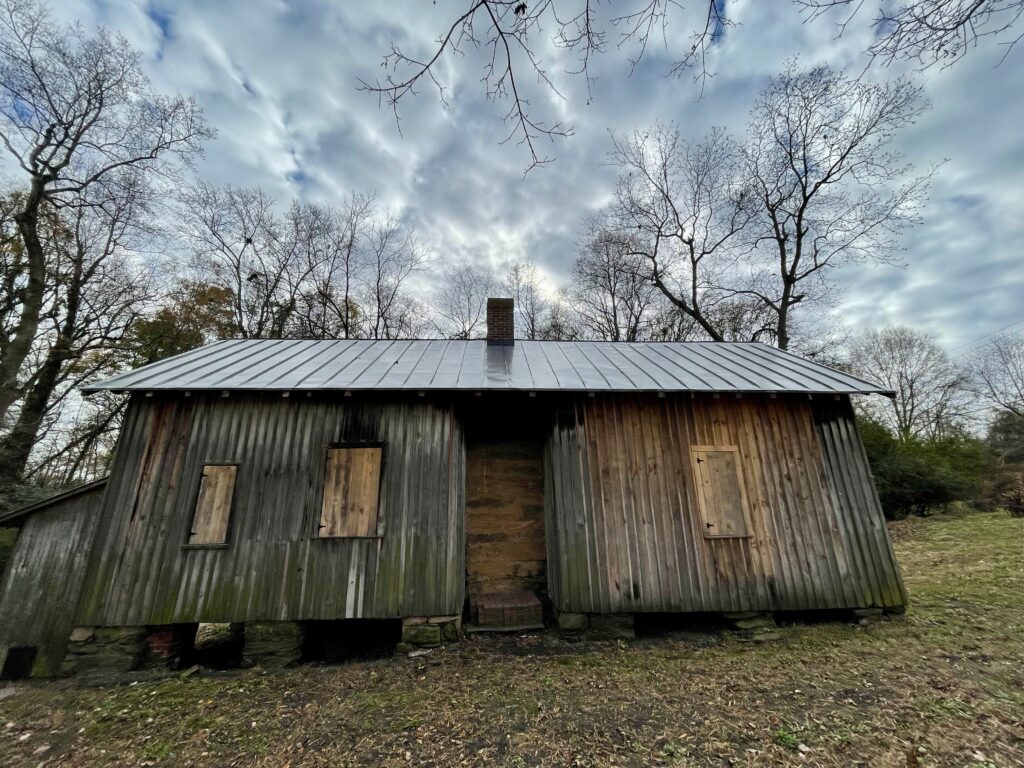
In the 1890s, his widow sold the house to an African American woman named Ailey Young, and her family, including husband, Henry, and son, Allen. Her son would grow up to establish the Wake Forest Normal and Industrial School, the first school for African Americans in the area. The Young family and their descendants lived in the building until 1967. It was purchased by the Town of Wake Forest in 1988, and then subsequently forgotten until over the past decade, when members of the Northeast Community, descendants of the Young Family, and the Wake Forest Historic Preservation Planner Michelle Michael began collaborative restoration efforts on the structure. Through their hard work, the building is now stable and restored. Small pieces of archaeological research have been conducted on the structure and surrounding grounds, including minimal unit excavation, ground penetrating radar, metal detector survey, and paint analysis. This week, the building is being painted.
The Digitization Project
This is where CHARG comes in. For this project, I get to wear multiple hats – both in my capacity as Director of CHARG, but also as the Manager of Archaeology and Research at The Wake Forest Historical Museum. WFHM has been a long time partner with the Town, and we are part of the Ailey Young House Advisory Council. Additionally, as an archaeologist who’s research has focused on African American domestic spaces, particularly double quarters, the building immediately peaked my interest. A still standing structure that was about to be painted, offered an immediate opportunity to become involved. And lastly, we have a chance to work with Robert Outland, a recent Wake Forest University Anthropology Alum (’21), and current MA student in Anthropology at University of Maryland. And thus, The Ailey Young House Digitization Project was born. The project has three essential goals:
- To develop 3D models and scaled drawings of the Ailey Young House interior and exterior using photogrammetry.
- Bring together all the previously gathered spatial data sets (GPR, Archaeological records, metal detecting data, and historic maps) to develop a comprehensive GIS database.
- Document and share the process and results of the project through an accessible web interface.
Data Collection
Last Thursday, on the heels of the good news that the North Carolina Preservation Consortium had provided CHARG with a research grant to acquire camera equipment for the project, we headed out to the Ailey Young House to take photographs. It was a beautiful overcast, cloudy, almost rainy day (ideal for photography because it meant no shadows or sun spots). We played leap frog with the painters, photographing each side of the building while they worked on the opposite side. Capturing the structure in its unpainted state because of the opportunity to capture the details in the architecture that would otherwise be hidden when the paint was applied.
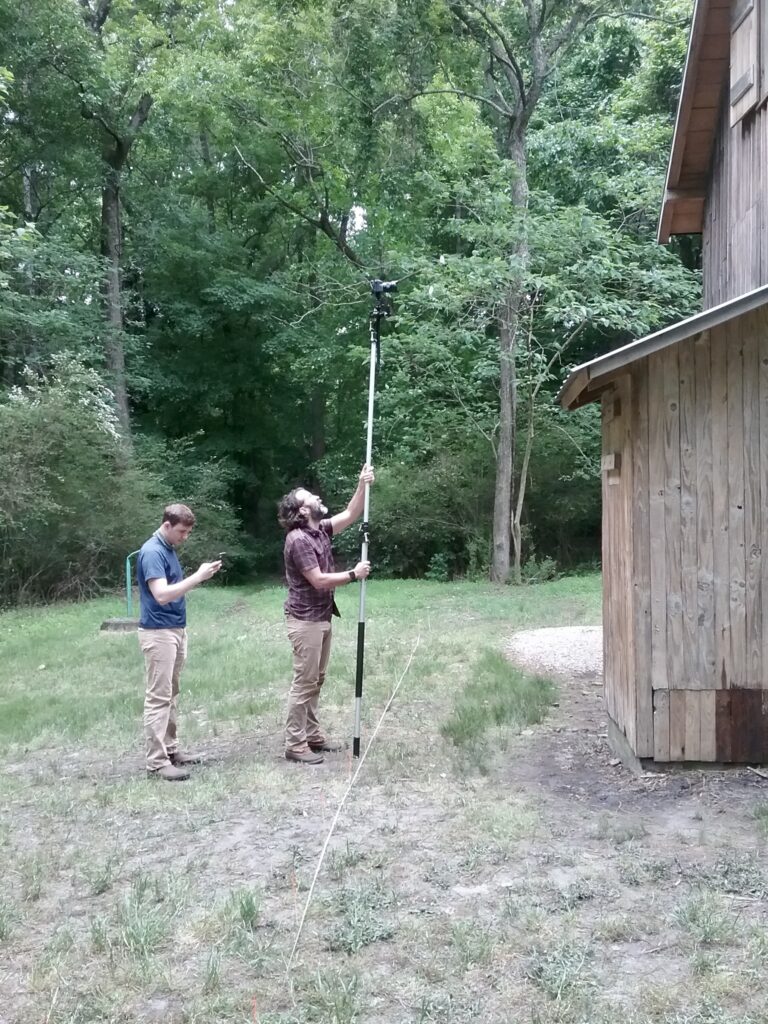
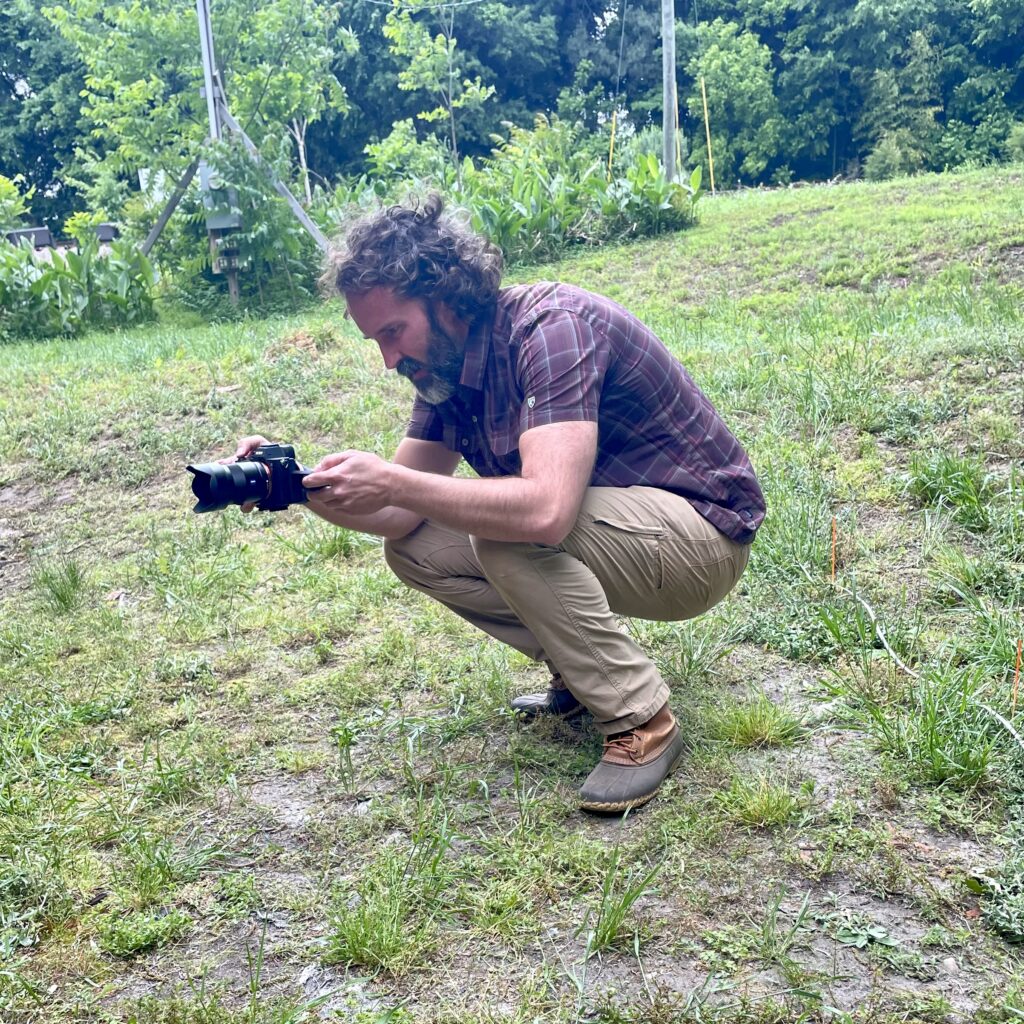
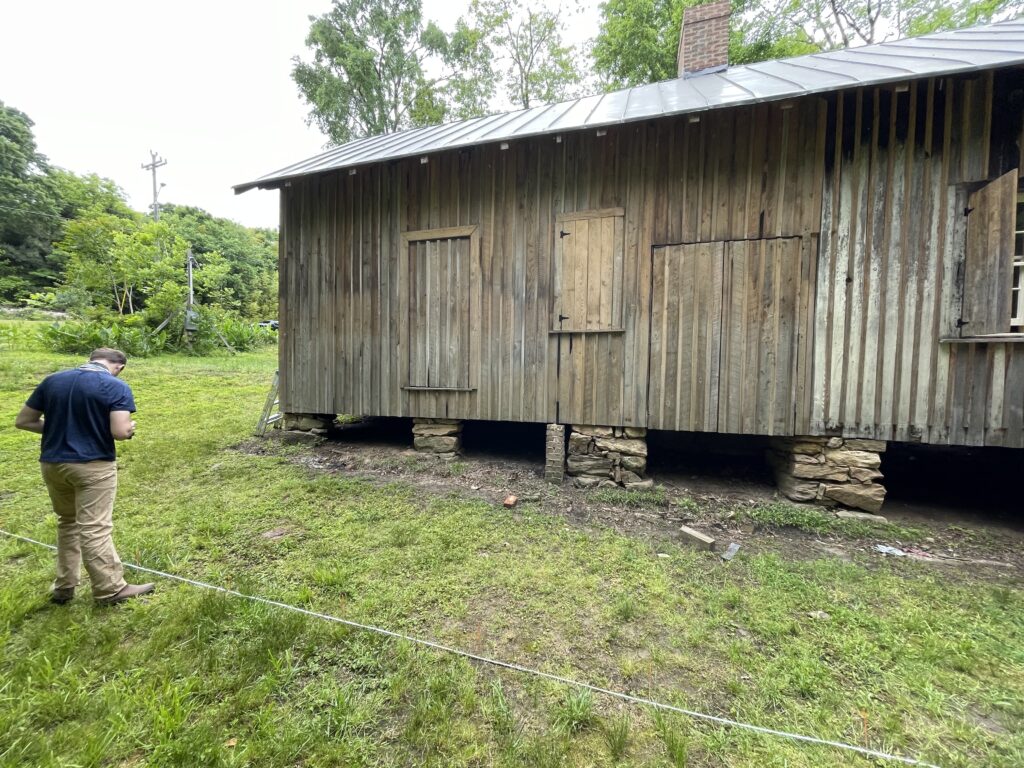
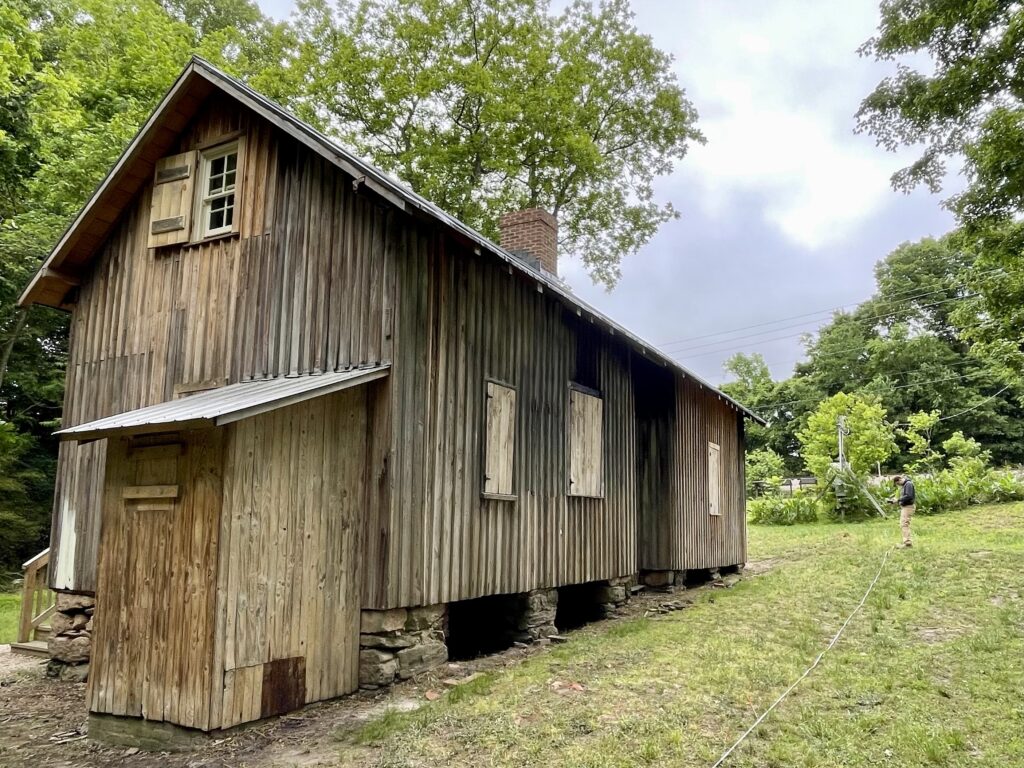
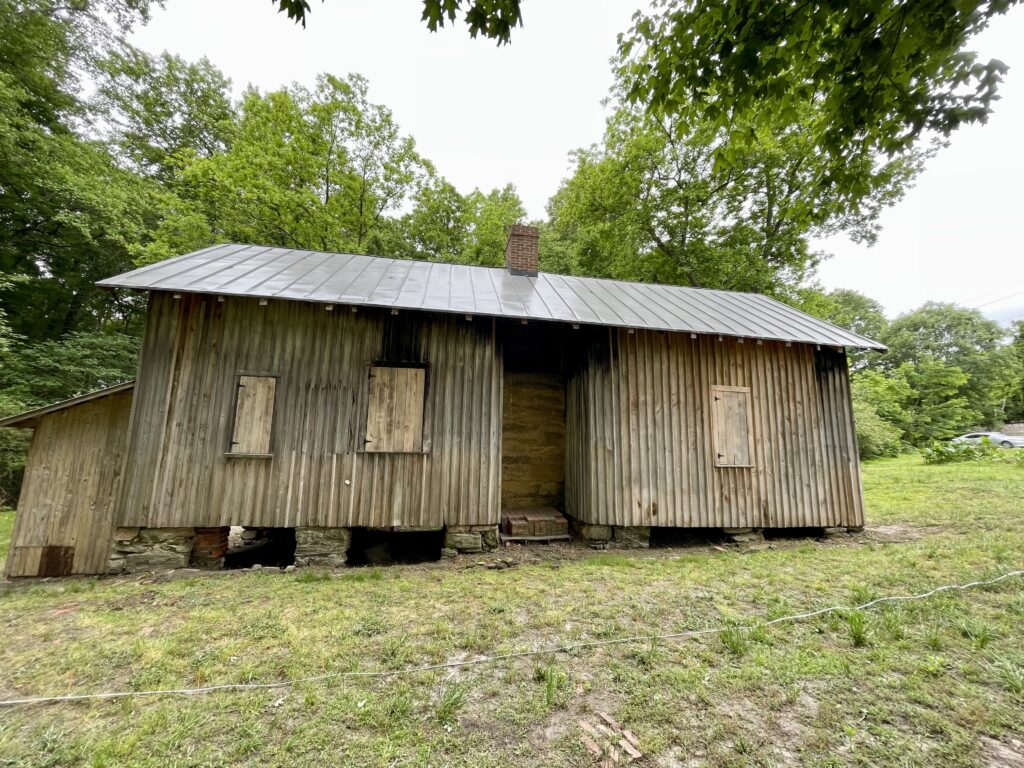
The idea behind photogrammetry is to take pictures of the entire building that overlap, and feed them through software that can identify and match up the photos, creating a 3D model of the building. While it is technologically more complicated than that, the data collection process means that we needed to take lots of photos, every few feet, from the same distance, and at various elevations. This meant putting our new camera on a giant pole, and extending it upwards of 20′ in the air. Even then, due to the steep slope the building is built on, we had trouble getting photos of the roof. It is likely that we took more photos then we needed, but in an era where space is cheep and when the building will be painted by the time we got home, more seemed appropriate.
The next steps are to get the photos into modeling software, and play with the processing of the information. This will likely take a while, and a number of iterations – Robby and I are both learning this process for a building of this scale. And of course, we’ll endeavor to keep you all posted as the project moves forward.
In the meantime, there are public webinars this week being hosted by the Town of Wake Forest and the Wake Forest Historical Museum. The first is May 18th at 6:30 pm by Christopher Robey, Master of Landscape Architecture candidate at the University of Georgia, who’s thesis is on Simmons’ Row. The second is May 25th at 6:30 pm by Sherry Boyette, Master of Arts in Anthropology candidate at NC State University, who’s thesis is on the archaeology conducted at Ailey Young House.

